Three AI reps a week, on your real work.
Five-minute tasks on work you already have, in the AI tool you already use. Paste it back, get one tip.
Ask Rep to write it and it says no.
Every time, in character. If Rep did the task you would practise nothing, and the tip you got back would be about a demo instead of about your work. So it hands you the task, points you at your own tool, and waits for what comes back.
Not this one, that is the whole point. Open ChatGPT, paste your reminder, and ask for it warmer and half the length. Two minutes. If it comes back stiff, tell it who the reader is and try once more. Bring me both versions.
Three reps close a week. Miss a day and nothing happens.
One arc per rep. Rep's mark is a week you closed, which is why it is the same object as the progress you see in the app.
Half the length, same message
Rewriting, about 5 minNaming the reader decides what survives the cut, and cutting is where you feel what the tool is good at.
Teach it your job once
Context, about 5 minThis paragraph is the one you paste at the top of every chat from now on, so the answer starts from your job instead of a generic one.
An agenda that ends on time
Planning, about 5 minAn agenda is structure, and naming the shape is the whole ask.
Miss a week and your run holds. One missed week is always forgiven, so there is nothing to protect and nothing to lose.
Those three are real tasks from Rep's own bank. The coach rewrites each one around the job you described, so yours will say your clients, your tools and your week.
The whole loop is four screens. Every one below is a capture of the running app on a sample account.
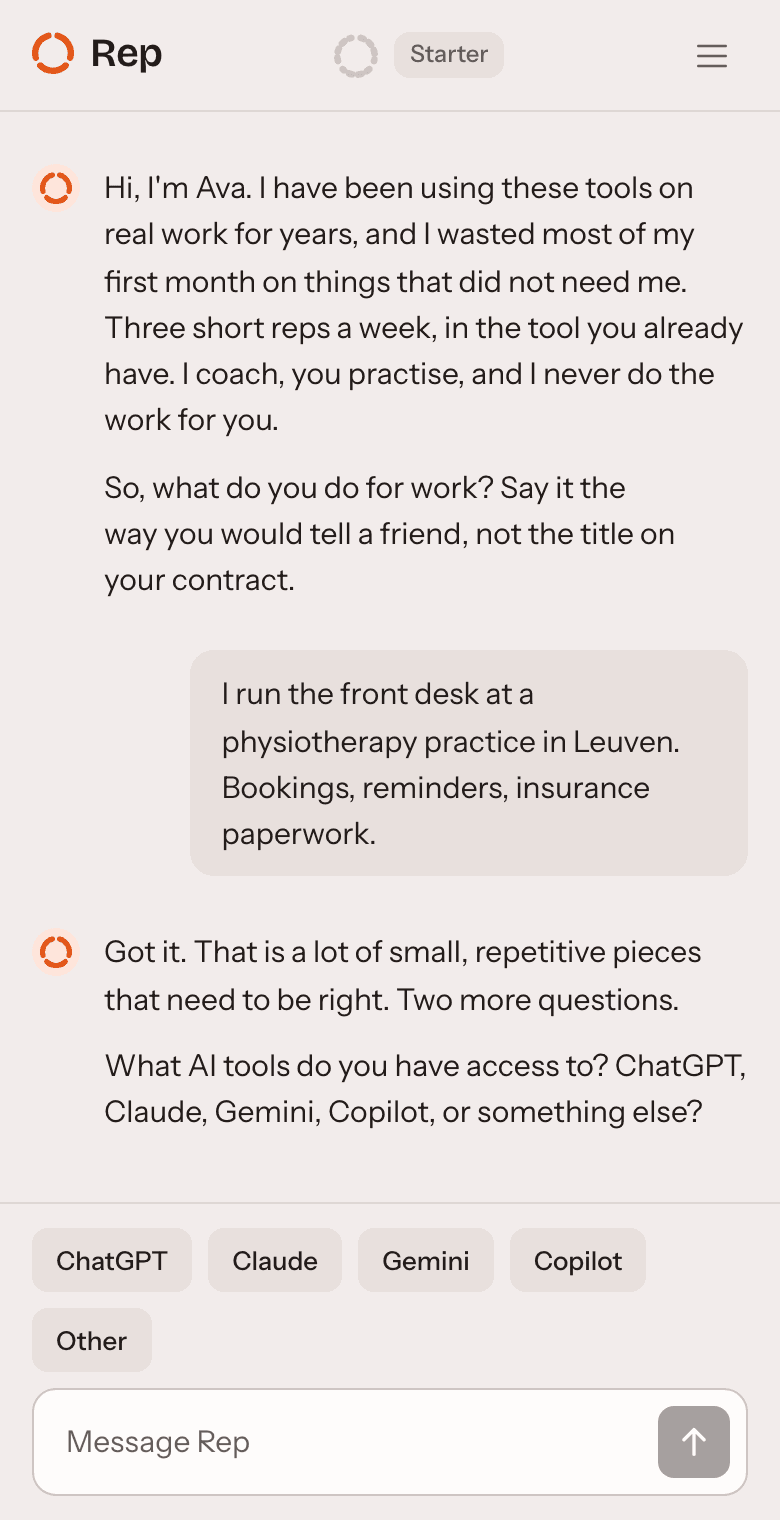
You say what you do. In your own words, not a job title from a form. Every task after this is built from that paragraph. 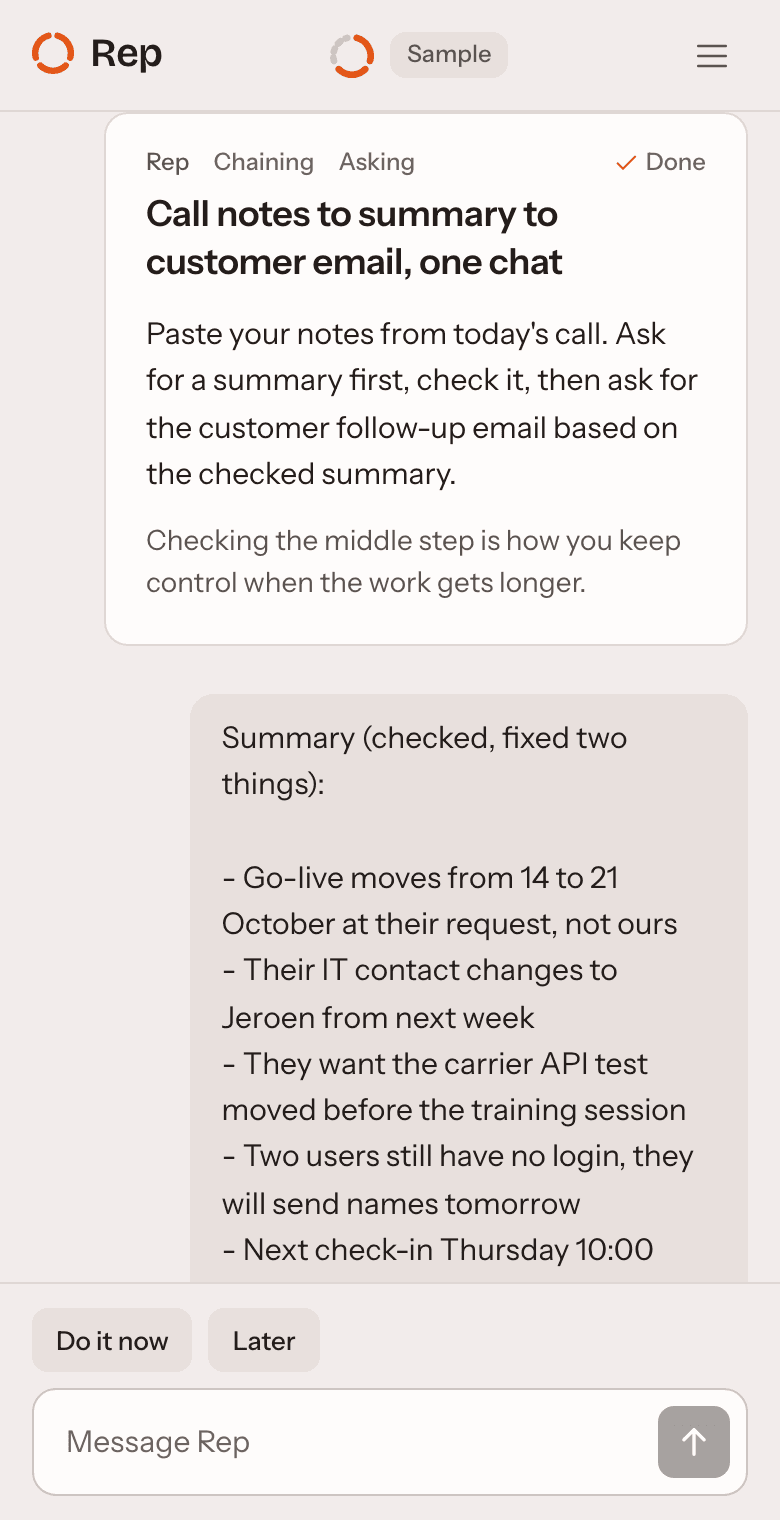
Rep hands you one task. On work you already have, with the way it usually goes wrong and a starter prompt for your own tool. 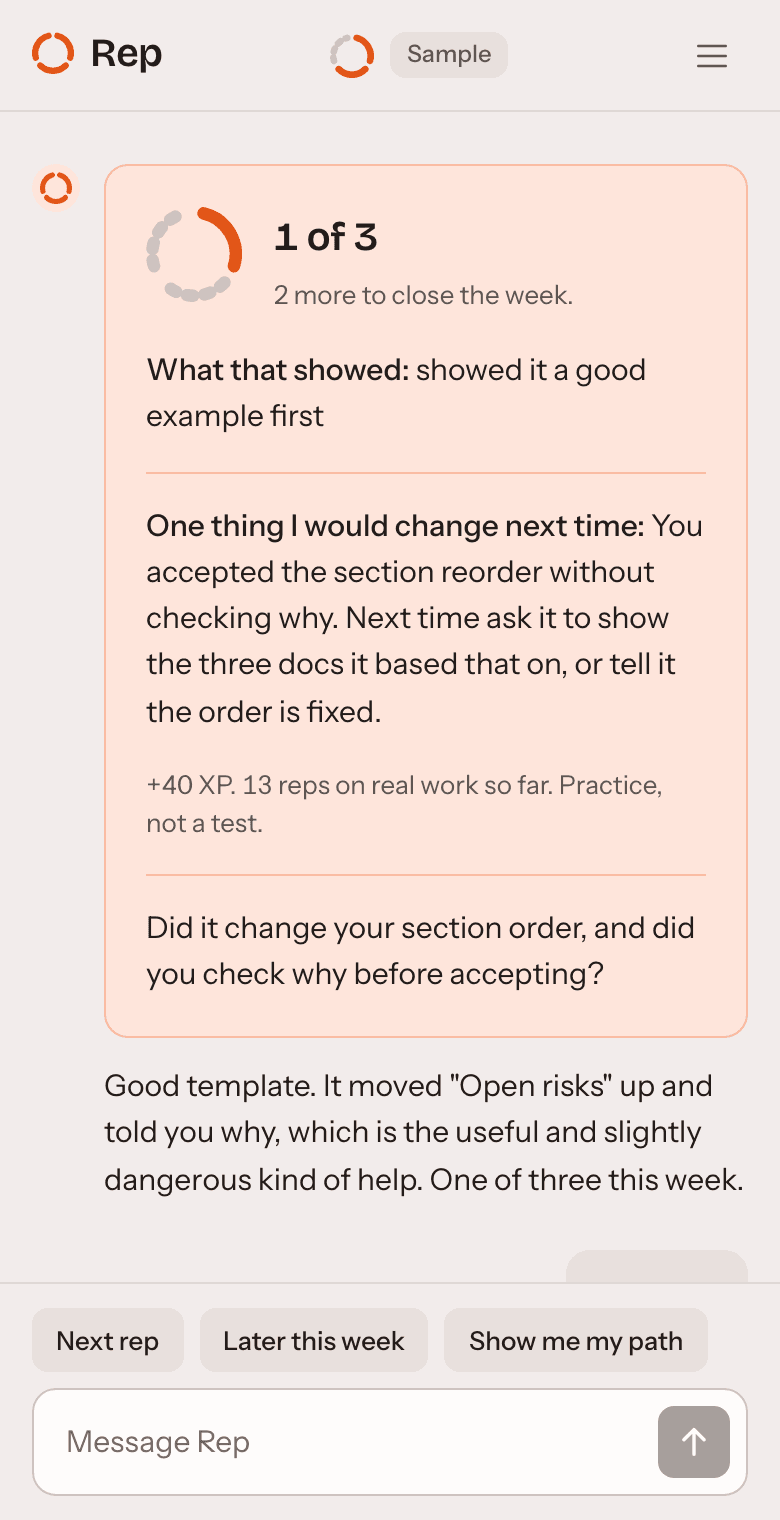
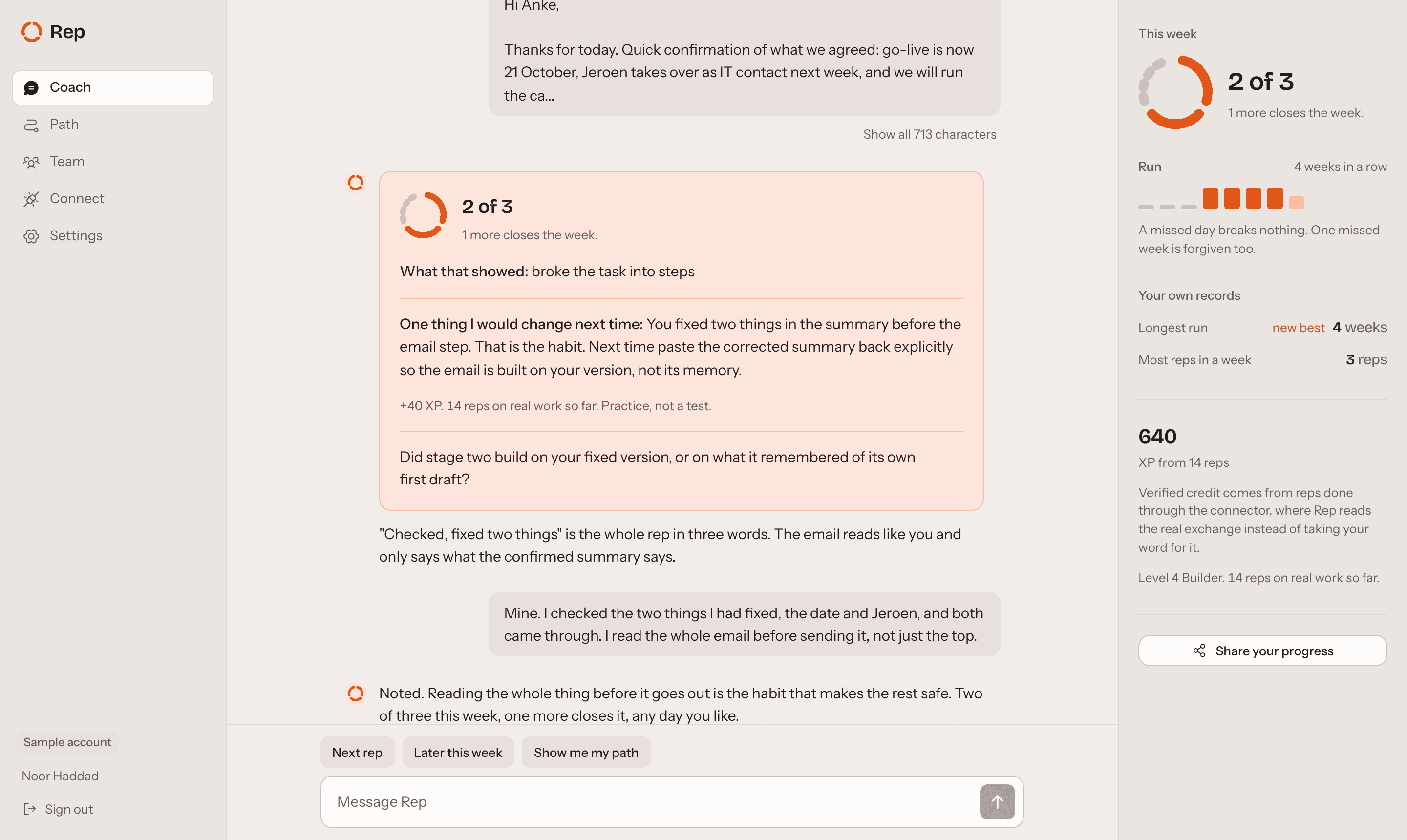
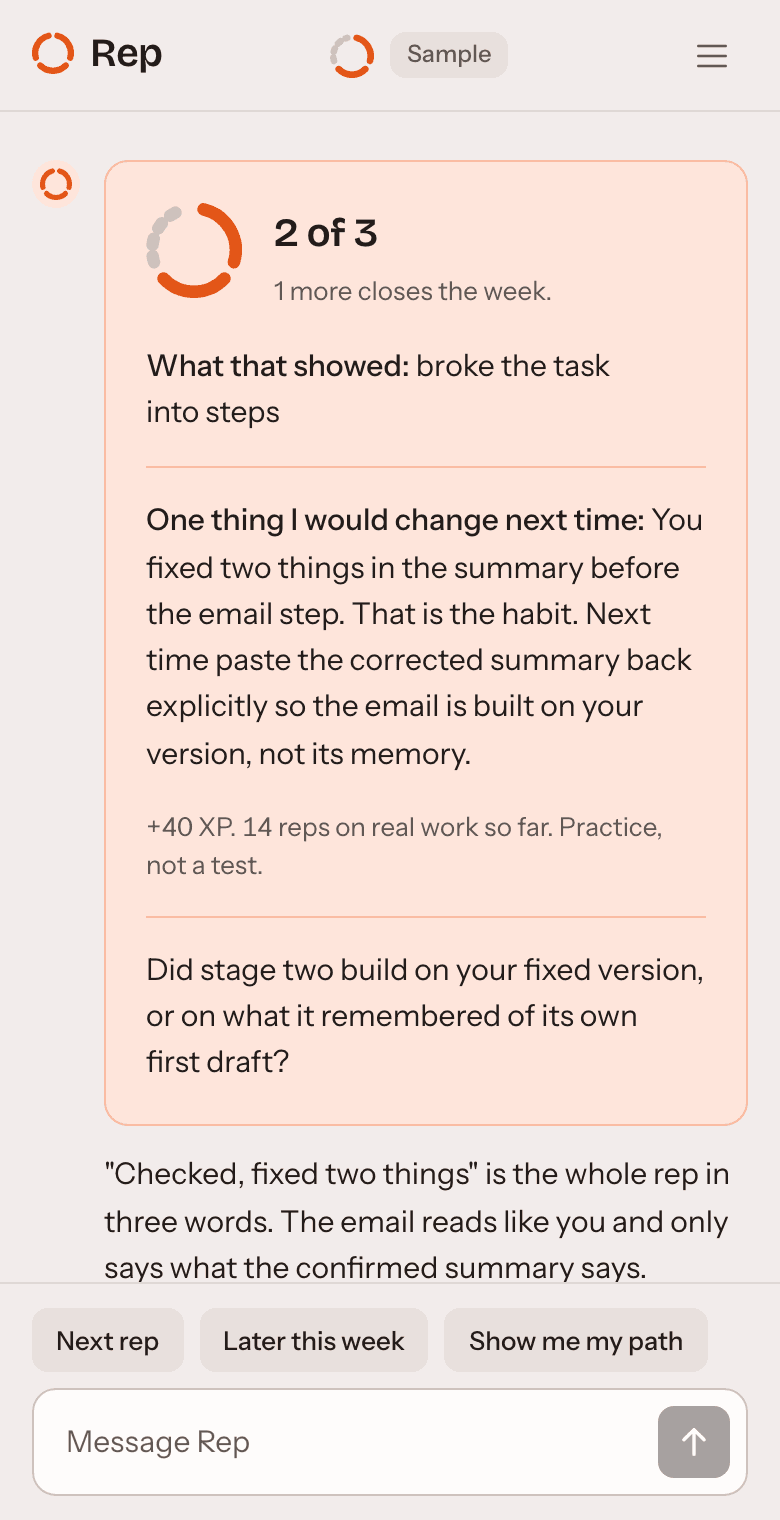
You paste what came back. Rep names the habit the paste showed and one thing to change. Then it asks you one question. 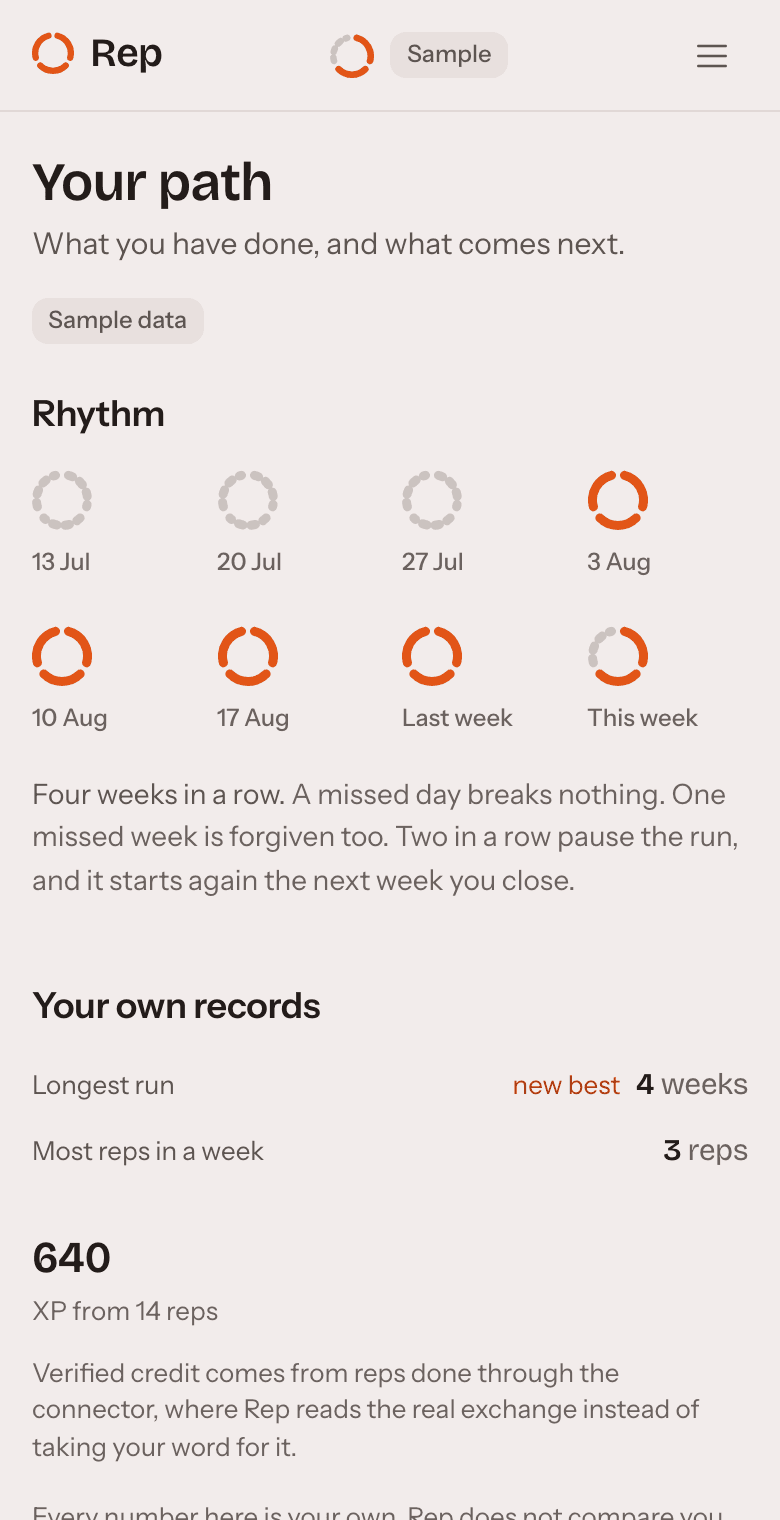
Your path is your own. Your rhythm and your own records. Nothing here compares you to another person, and nowhere in Rep does.
Rep counts what happened, not what you meant to do.
There is no button in Rep that marks a rep done. The only thing that closes one is work coming back from your own tool.
Counts as a rep
- Work you did in your own AI tool and pasted back.
- The prompt you actually sent, in your words.
- A second try, after the first answer came back wrong.
Does not count
- Opening Rep.
- Reading the tip.
- Telling Rep you did it.
Nothing is marked right or wrong. Rep reads the paste, names the habit it showed, and gives you one thing to change next time. That is the whole feedback the product gives.
For a team, the manager goes first.
Encouragement from the person you report to is the strongest lever in the whole adoption literature. Take-up went from 47% to 83% when the employer encouraged use, in a payroll-linked study of 25,000 workers.
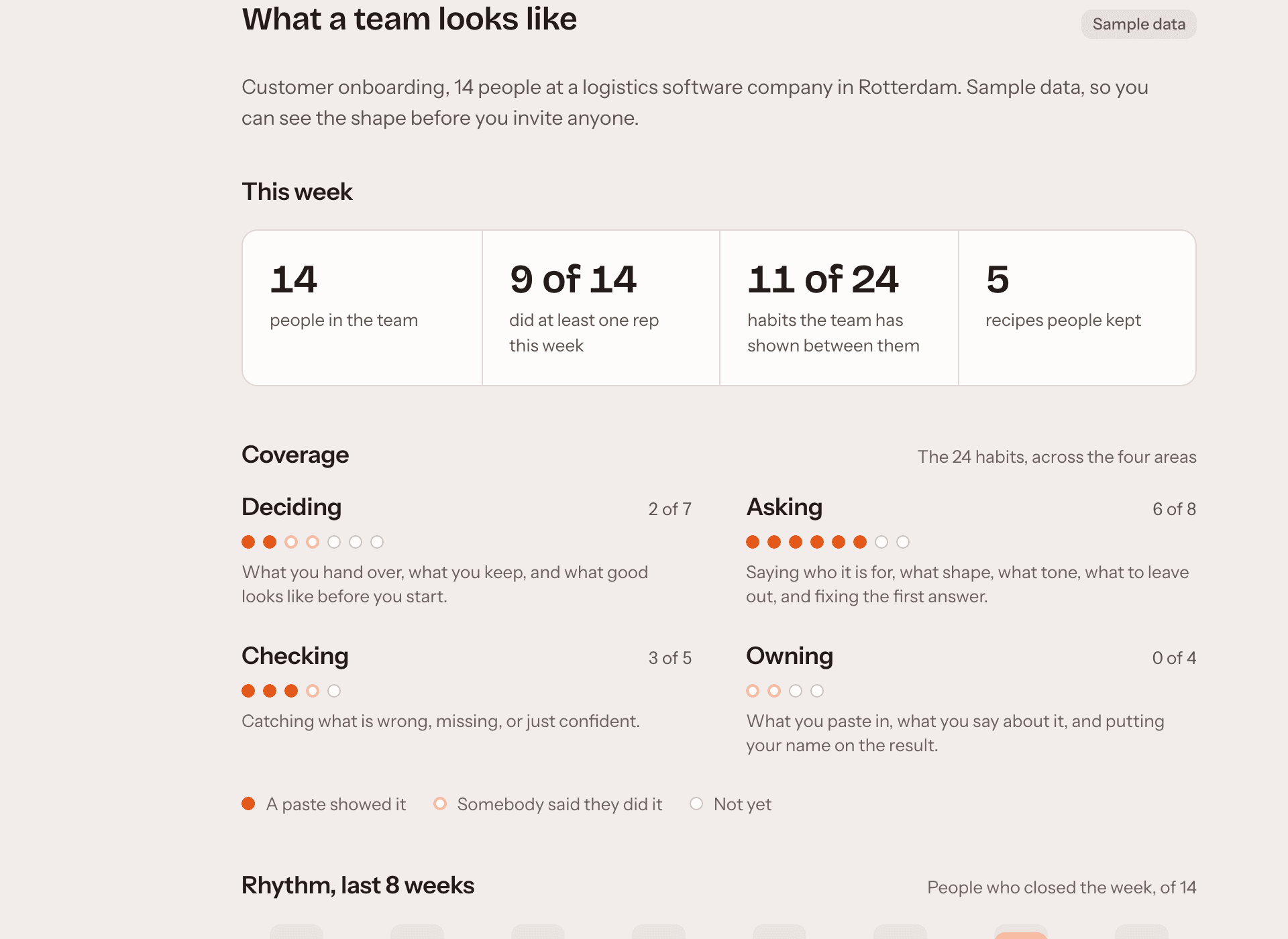
So a team on Rep starts with the owner doing a rep in the open, and everyone else opts in. The team view shows coverage and rhythm. It never shows one person's progress to another, and there is no list of who is ahead.
What the research says, including where it rules out the fun parts.
Most AI training teaches people about AI. Rep follows the evidence on what makes people use it, and that evidence is what removed the mechanics you would expect to find here.
- Weekly, not daily.
A review of 22 studies of classroom practice found fixed seven-day intervals give the most consistent spaced-practice effect, d = 0.54. Habit runs on total repetitions in a stable context, not on consecutive days, so a missed Tuesday is not a broken habit.
Mawson and Kang, Behavioral Sciences, 2025. Lally, van Jaarsveld, Potts and Wardle, European Journal of Social Psychology, 2010.
- Practice has to be on your own work.
Across 117 studies of behaviour-change training, transfer to the job was greatest when people practised on scenarios they brought themselves, set their own goal, and their manager had been through it too. Toy exercises do not transfer.
Taylor, Russ-Eft and Chan, Journal of Applied Psychology, 2005.
- Feedback that informs beats a reward.
Across 128 experiments, positive informational feedback raised free-choice behaviour by d = 0.33, while tangible rewards moved it the other way. So Rep gives you one specific thing to change, and nothing to collect.
Deci, Koestner and Ryan, Psychological Bulletin, 1999.
- Leaderboards backfire.
A preregistered study with 4,439 participants found a reputational penalty for visible AI use: people judged as lazier and less competent. Rankings make it worse.
Preregistered study in PNAS, 4,439 participants.
Questions
What does it cost?
Nothing. Rep is free, and there is no paid plan. It exists because most AI training teaches people about AI instead of getting them to use it.
Which AI tools does it work with?
Whatever you already have: ChatGPT, Claude, Gemini, Copilot, or anything else. Rep never replaces your tool. It hands you a task and takes the result back.
Does Rep write things for me?
No. Rep refuses, in character, every time. If it did the work you would practise nothing. It gives you a starter prompt and sends you to your own tool.
What happens if I miss a week?
Nothing bad. Rep runs on weeks rather than days, and your run forgives one missed week. Nothing turns red and no message tries to make you feel bad about it.
Is there a leaderboard?
No, and there never will be. Visible AI use gets people judged unfairly by colleagues, and rankings push people to hide what they know. Rep shows your own progress to you.
Does Rep watch what I do in ChatGPT?
No. Rep only ever sees what you hand it, and today that is the text you paste. When you connect Rep to ChatGPT or Claude, it reads the one exchange you submit and nothing else.
What do you store?
Your email if you give one, what you tell Rep about your job, the tasks it built for you, and what you paste back. Pasted work is processed by a language model to write the tip. Delete everything from settings, one click.